Focus Areas
- Machine learning in the field of agriculture and vegetation
- Classification methods, such as supervised learning, unsupervised learning, self-taught learning
- Feature learning, representation learning
- Interpretability and explainability for deep neural networks
- Analysis techniques, such as clustering or archetypal analysis
- Pattern recognition in large data sets
Topic Propositions
Deep learning based pollinator detection in Agri-Photovoltaics

Context/Introduction
Agri-Photovoltaics (Agri-PV) combines agricultural production with renewable energy generation on the same area of land. This dual land use can increase land-use efficiency, provide additional income opportunities, reduce heat and drought stress through partial shading and lower evapotranspiration. At the same time, photovoltaic modules alter local conditions by changing light availability, shading patterns, temperature, soil moisture, wind exposure, sowing and vegetation density. From an ecological perspective, an important open question is how these modified microclimatic and structural conditions affect pollinators such as bees, moths and other insects. For this thesis, a rail-based camera system mounted above an Agri-PV field provides very-high-resolution image time series with dense temporal spacing, including multiple acquisitions per day. These data allow pollinator activity to be studied at a fine spatial and temporal scale.
The aim of this thesis is to evaluate and refine a deep learning based object detection workflow for detecting different pollinator groups in Agri-PV imagery. The resulting detections will be used to analyse spatio-temporal activity patterns, for example differences in pollinator counts between shaded and non-shaded areas, or different times of day. General methodological challenges of deep learning based pollinator detection in fields include (1) very small object sizes, (2) dense and visually cluttered vegetation backgrounds, (3) class imbalance between different pollinator groups, and (4) substantial changes in object appearance over time due to shifts caused by weather and/or plant growth stage. In Agri-PV imagery, PV panels additionally cause spatially varying illumination conditions, which simultaneously affect pollinator activity and its detectability by means of computer vision. Pollinator activity is likely to be altered indirectly due to changing environmental covariates, which in turn affect plant growth. The detection ability of pollinators by means of computer vision is affected due to models sensitivity to distribution shifts in the input data. This thesis therefore investigates how existing object detection models can be adapted to such challenging Agri-PV image time series and how robust detections can support ecological analyses of pollinator activity.
Possible directions
• evaluation of existing object detection models, such as YOLO-, Faster R-CNN- or DETR-style architectures, for detecting bees, moths and other insects in very-high-resolution Agri-PV imagery
• analysis of model robustness under Agri-PV-specific image conditions, including panel occlusion, cast shadows, dense and temporally changing vegetation
• evaluation of whether temporal information, targeted data augmentation, shadow-aware preprocessing or post-processing can improve detection performance and reliability
• spatio-temporal analysis of pollinator activity patterns, for example comparing shaded zones, panel edges, open crop rows, vegetation-density gradients and different times of day/year
Prerequisites
Familiarity with deep learning pipelines and computer vision models is expected. Experience with PyTorch and object detection workflows is appreciated. Basic interest in ecological applications, spatial analysis and time series data is useful but not required
Supervision: Lennart Reißner, Felix Kröber, Ribana Roscher
Comparing Pre-Training Strategies for Sparsely Labeled Land Cover Classification
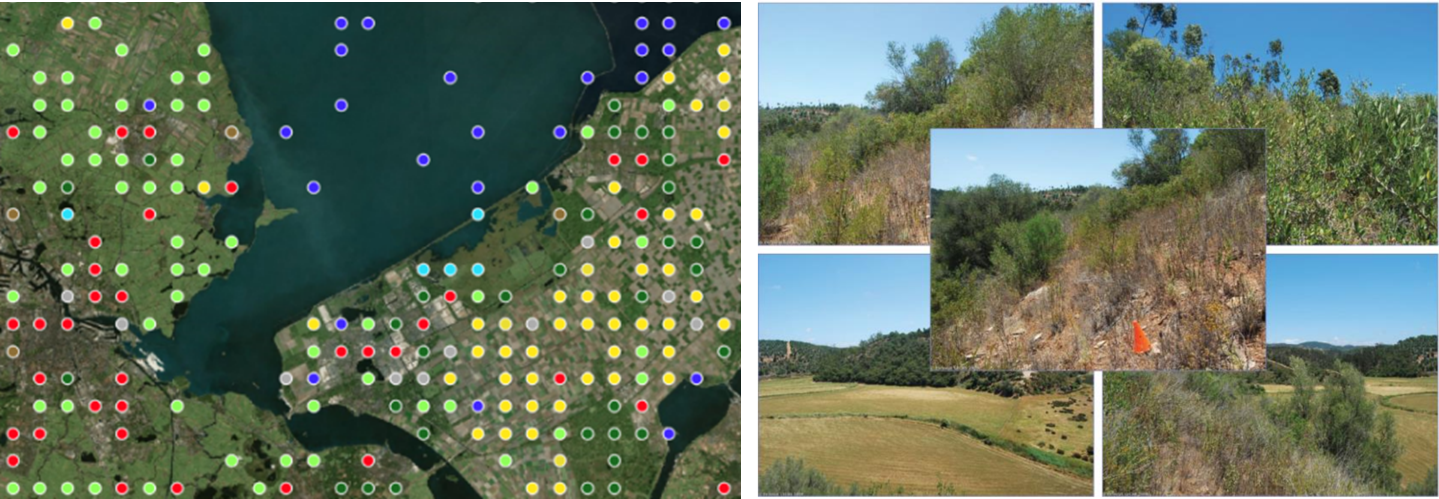
The use of survey data like Eurostat LUCAS for training land cover classification neural networks is an appealing alternative to the common practice of manual annotation. However, such data is sparse compared to satellite images’ spatial resolution, meaning that only a select few image pixels can be labeled. A popular way to improve the performance of neural networks in the face of data sparsity is pre-training. In this thesis, different pre-training strategies shall be compared by applying them to a dataset of Sentinel-2 and LUCAS data. In particular, we are interested in how pre-training on existing land cover datasets compares to domain-agnostic self-supervised techniques like image reconstruction or contrastive learning.
Supervision: Johannes Leonhardt, Ribana Roscher
Renaturation detection using esa Worldcover Maps of 2020 and 2021, and Sentinel-2 imagery (Bachelor Thesis)
German title: Detektion von Renaturierung unter Verwendung der ESA WorldCover karten von 2020 und 2021, und Sentinel-2 Bildern
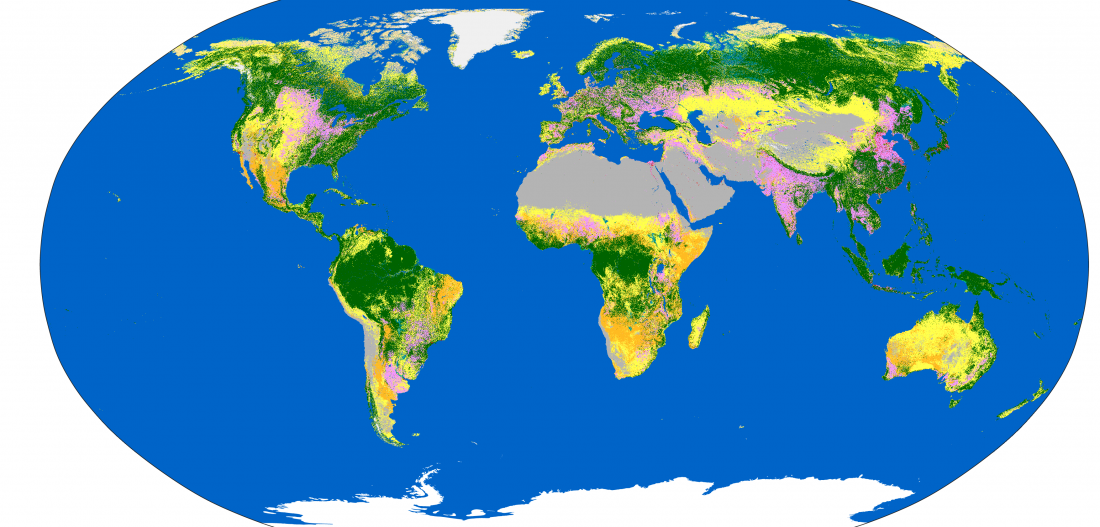
ESA WorldCover is a land cover dataset with 10 meters resolution which has been published for the years 2020 and 2021. Land cover changes within these two maps might reveal renaturation areas. However, since different algorithms have been used to generate the maps, differences might not only occur due to real land cover changes. Therefore, Sentinel-2 images must be used to validate the land cover changes in the ESA WorldCover maps.
Supervision: Ribana Roscher
Analyzing Sleep Patterns in Calves (Bachelor or Master thesis)
German title: Analyse des Schlafes bei Kälbern


Sleep is an important part of life, from human studies we know, that a lack of sleep can have a significant effect on health and welfare. It can be assumed that sleep also plays a role in farm animals – but scientific evidence is rare.
To analyze sleep a combination of different physiological parameters (electroencephalogram (EEG), electrooculogram (EOG) and electromyogram (EMG)) can be measured using mobile sleep labs. In the ‘Calf Sleep’ project, such polysomnographic data is recorded, furthermore we record the behavior of the animals in order to validate alternative methods for the measurement of sleep on farm.
Up to date, the data has to be analysed manually, which is both, time consuming and prone to errors. The aim of two master thesis is to develop algorithms to automate and thus significantly simplify the analysis of this data:
- Development of machine learning algorithms to analyze different body positions of calves.
- Development of a pattern recognition algorithms to analyze different sleep stages from polysomnographic data.
Supervision: Ribana Roscher, ITW Bonn
Detection Of Iceberg Rafted Debris in X-Ray Cores
German title: Detektion von Eisberg-Geröllen in Röntgenaufnahmen von Bohrkernen

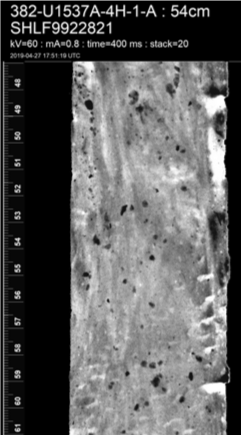
Analyzing the current and past behavior of the Antarctic ice sheet is a major research area to get information about the long-term climate history of Antarctica and to predict the future behavior of the ice sheet. As soon as wandering icebergs reach warmer waters, the debris they carry (so-called iceberg rafted debris) falls down through the ocean as consequence of the melting process. The debris is deposited as sediment on the seafloor and gives, when analyzed, valuable information about changes in the ice sheet.
This thesis is concerned with an automatic algorithm to detect debris in x-ray images of drill cores, which were collected during an Antarctica expedition in 2019. Supervised learning with convolutional neural networks will be utilized to detect debris and estimate position and size in the drill core. The algorithm will be analyzed by manual annotations provided by experts.
Supervision: Ribana Roscher, Mike Weber (Institute for Geosciences Department of Geochemistry and Petrology)
Exploring the Sensitivity of Model Uncertainty to Hyperparameter Variations: A Systematic Analysis
Imagine this: you’ve trained a deep learning model that predicts traffic patterns. It seems perfect on the test set—accurate, efficient, and ready to deploy. But can you trust it to handle rare, unpredictable scenarios, like a sudden traffic jam caused by an accident?
This is where uncertainty estimation steps in, acting like a reliability score for machine learning models. In critical applications like healthcare, autonomous driving, and financial forecasting, knowing not just what a model predicts but how certain it is can make all the difference between success and failure.
But here’s the twist: the reliability of uncertainty estimation isn’t set in stone. It’s shaped by our choices we make during model training—like how fast we let the model learn (learning rate) or how often we drop connections (dropout rate).
This study explores a simple but profound question: How do these hyperparameters influence model uncertainty? By uncovering the hidden relationships between hyperparameters and uncertainty metrics, this thesis aims to guide practitioners toward building models that are not only accurate but also confident.
More details:
Supervision: Mohamed Farag , Ribana Roscher
The Effect of Architecture Selection on Prediction Uncertainty
Imagine designing a rocket. The materials and structure you choose will determine not just how high it can fly but also how reliably it can withstand turbulence. In machine learning, architectures are the blueprints, shaping not only what a model predicts but also how confident it is in those predictions.
As machine learning expands into critical domains like autonomous driving and medical diagnostics, prediction uncertainty has emerged as a measure of reliability. But how does the choice of architecture—from traditional CNNs to cutting-edge Vision Transformers—affect prediction uncertainty? This study investigates the relationship between architecture and uncertainty, aiming to provide practitioners with the insights they need to pick the right one for the downstream task.
More details:
Supervision: Mohamed Farag, Ribana Roscher